New York, London, Sydney, Beijing, Paris and more modern cities offer unique travel experiences; in contrast, just a few hours from smaller cities like Cusco you can find impressive ancient cities that resisted Spanish colonization and now face the passage of time—one of them is the Archaeological Park of Choquequirao.
Choquequirao is an Inca citadel larger than Machu Picchu and is only accessible via trekking routes. If you want to secure a trekking adventure in a little-visited area, Choquequirao is for you.

The mystery of the last Inca stronghold
The mystery of Choquequirao begins with its name; Choquequirao is a word in ancient Quechua that means “Cradle of Gold” (chuqi = gold, k’iraw = cradle); it is believed that this name is mainly due to its sacred location between Cusco and Apurímac.
In academic research, the Choquequirao Archaeological Park was first mentioned by the French explorer Charles Wiener (19th century). Wiener notes the presence of “three palaces aligned from North to South” (1993, 308). It was only from 1993 that local institutions such as Copesco began conducting the topographic survey of this citadel. Although Choquequirao is considered the last stronghold of the Incas, where the final rebels fighting against Spanish colonization resided, more recent research suggests that there is a possibility that the Choquequirao Archaeological Park may have been “known and controlled by the Spanish” (Duffait; 2005), since there are records identifying the location of Manco Inca and his sons in the Vilcabamba mountain range. Even today, the subject remains under debate.

Inca architecture in Vilcabamba
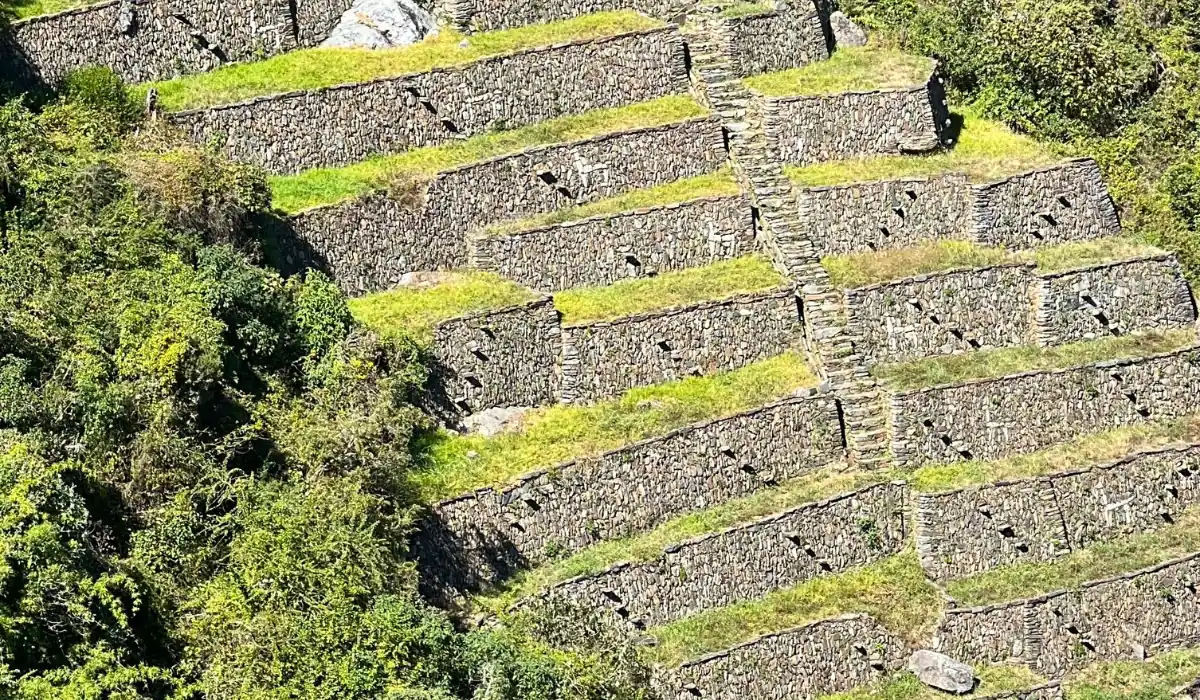
The Inca city of Choquequirao stands out for its Inca architecture. In Choquequirao you can find zoomorphic mural decorations; terraces with mural decorations; hydraulic systems and road systems, which once again exemplify the vast knowledge the Incas possessed about geography and architecture.
- The llamas of the sun: in the walls of the Choquequirao Archaeological Park you can find stone mosaics. It is necessary to mention that “the construction of the terraces has in all cases started from the bedrock, which was excavated to build the wall” (Echevarría & Valencia; 2008, p. 72).
Currently, this Inca city continues to be under research, so it is expected to be larger than what can currently be observed.

Trekking to Choquequirao
Despite its location in the impressive setting of the Vilcabamba mountain range, finding a one-day tour to Choquequirao is extremely difficult because it is not a place massively visited by tourists like Machu Picchu, Humantay or the Sacred Valley, so there are no daily departures and it is important to book a tour in advance. When traveling with us, we guarantee:
- Exclusivity before the cable car: currently the only way to access Choquequirao is by land route. The route is pristine, with few tourists and challenging—you will push your limits with every step! Enjoy trekking to Choquequirao before the construction of the cable car takes place.
- Positive impact: by choosing a trekking route operated by locals, you directly support the local economy of the communities that maintain the trails and protect the cultural heritage.
- Reduced carbon footprint: by traveling in small groups, you reduce soil erosion and are less invasive to animal habitats.
- First connection with the Peruvian jungle: on your journey to the Choquequirao Archaeological Park, you will experience the transition from the highlands to the jungle, allowing you to get a sense of what a trip to the Peruvian Amazon will be like.
Choquequirao reveals a new side of Inca history. Are you ready to conquer your limits and make history? Get your Choquequirao trekking now.