Kusicancha Inca Palace: the palace where one of the greatest emperors was born.
Most travelers queue at the best-known archaeological and historical sites in Cusco, however, a few meters from Qoricancha there is still a palace that silently resists the passage of time and watches different cultures appear, resist or disappear. This place is the Kusicancha Inca Palace.
Throughout history, the Kusicancha Inca Palace has gone through various processes of destruction, remodeling, and reconstruction. While Peru was going through various historical periods, Kusicancha was latent, waiting for the day that its historical and cultural value would be recognized again.
The Kusicancha Inca palace throughout history
Inca Era
In Inca times, it is believed that Kusicancha was the birthplace of Inca Cusi Yupanqui, whose name is currently interpreted as “joyful prince.” Later, the Inca changed his name upon assuming power and was called Pachacútec, his name representing the transformation of the earth. Honoring his name, Pachacútec expanded the Inca Empire, reorganized Cusco, and ordered the construction of Machu Picchu. Subsequently, the Kusicancha Inca Palace came under the care of the royal panaca due to its strategic location in the center of Cusco and its proximity to the Qoricancha Temple, which was the most important sacred temple of the empire.
The palace was also used as a place for the elaboration of various goods that were used in ceremonies such as drinks.

Viceroyalty Era
During the Spanish colonial era, the Kusicancha palace was occupied by the Spanish, and there was no clear division of the area. In 1808, Kusicancha housed Spanish troops, and therefore the palace was constantly intervened to be adapted to the needs of the Spanish troops. Today, remnants of the constructions carried out by the Spanish colony can still be found.
Republican Era
The continuous use of the Kusicancha facilities caused it to be destroyed, expropriated, and new constructions to be made with the aim of continuing to be used as a barracks.
1900s Era
Military use wore down the Kusicancha palace facilities and its Inca and viceregal structures. The military destroyed walls and built new ones using brick and concrete, destroying several Inca walls that still resisted the passage of time along the way. In 1951, after the earthquake in Cusco; George Kubler, a prestigious researcher from Yale University, mentioned in his report “Cusco Reconstruction of the City and Restoration of its Monuments” the importance of relocating the barracks.
Subsequently, in 1990, former president Alan García promulgated Law N° 25259 which declared the recovery of the “November 27 Barracks,” now the Kusicancha Inca Palace, a matter of public necessity.

What is the importance of the Kusicancha Palace?
Besides being the birthplace of Inca Pachacutec, one of the greatest emperors, the Kusicancha palace was also an important ceremonial center due to its proximity to the Qoricancha temple. Currently, remnants of ceremonial artifacts as well as vessels and other utensils used to prepare the elements present in sacred rites can be found. In addition, its central location represents the importance of geographical distribution for the construction of cities in the Inca era.
Why visit the Kusicancha Palace?
Visiting the Kusicancha Palace is essential because it allows you to immerse yourself in Inca architecture at your own pace. If it’s your first day in Cusco, visiting this area is ideal for acclimatizing before starting the Cusco tours.
What is the entrance fee to the Kusicancha Palace?
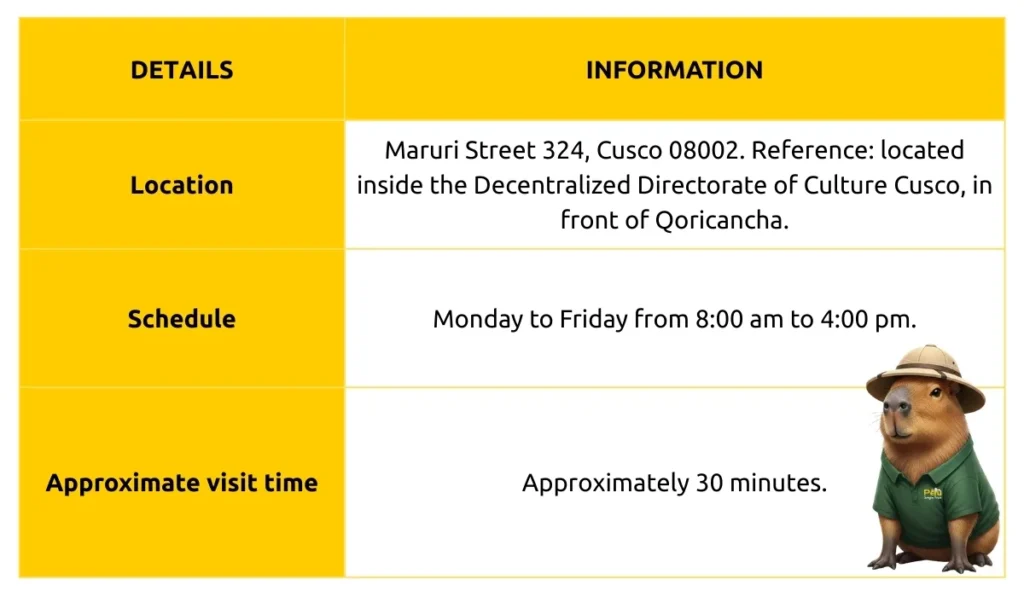
Entrance to the Kusicancha Palace is free for both national and foreign tourists. In the following table, we provide detailed information.